
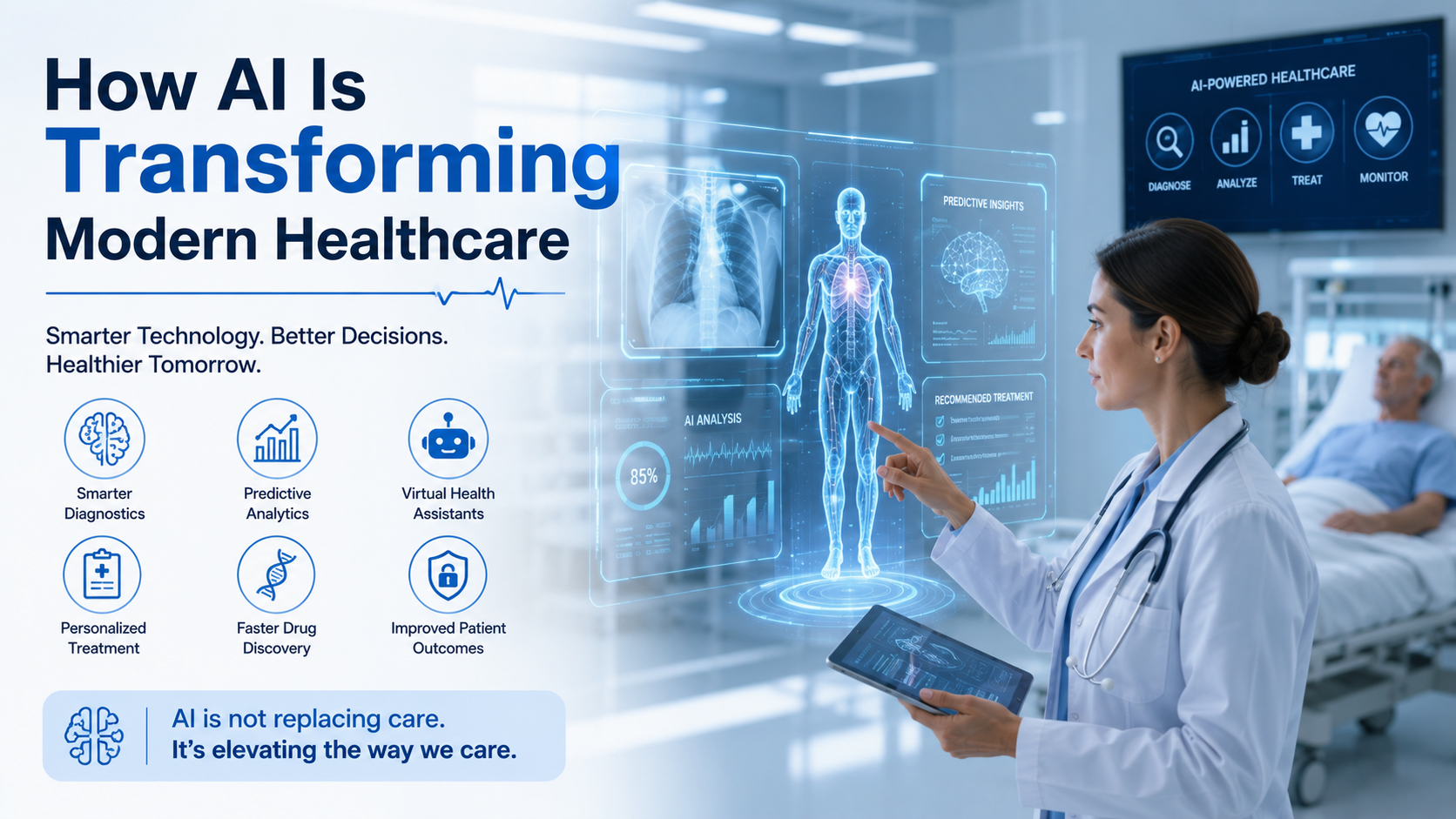
How AI Is Transforming Modern Healthcare
Artificial intelligence in healthcare is something which is very commonly talked about today, but what it is actually changing is something most people are not fully aware of. Most people who hear about AI in healthcare have the wrong picture of it entirely. Robots replacing doctors, machines making decisions, humans being removed from the process. But reality is different and far more interesting than that.
What is actually happening is closer to home than most people think. This is not some distant future thing; healthcare is already running on it in ways more people are feeling the benefit of than they probably realize. Here is a look at how AI is changing modern healthcare, and why all this matters to the average person.
AI in Healthcare Is Not a Future Story
Not much seems different if you are just looking from the outside. People still book appointments, still see their doctors, and still get sent for tests. The routine looks the same from a patient's perspective. But the tools being used and the speed at which decisions are being made are changing significantly underneath that familiar surface. By the time most people notice, the transformation has already been underway for quite some time.
AI is not a future possibility in healthcare. It is already here and already working. Diagnostic imaging, drug discovery, patient monitoring, and administrative processes. These are not experiments. They are already part of how healthcare systems operate around the world.
What Problems Is AI Actually Solving?
Healthcare has always struggled with the same two things. Volume and time. The number of scans a doctor needs to review, the number of trials a researcher needs to analyze, and the number of records a hospital needs to manage. The amount of information involved in modern healthcare is beyond what any team can process consistently without the support of some kind.
AI is built specifically for this kind of problem. It processes large volumes of data quickly, identifies patterns that are difficult to detect consistently and flags information that needs human attention. It does not replace the doctor making the decision. It gives that doctor better and faster information to work with.
How AI Is Catching What the Human Eye Might Miss
Diagnosis is where the impact of AI is most visible right now. A radiologist sitting down to review a scan is no longer starting from scratch. An AI system has already gone through it, flagged what needs attention and highlighted areas that are easy to miss in the early stages. For conditions like cancer and cardiovascular disease, that head start changes what is possible significantly.
Most people do not realize this is already happening in modern diagnostic centers. Early detection leads to better outcomes, and AI is making early detection more consistent and more accessible than it has ever been before.
Pathology is another area seeing real change. Tissue samples, abnormality detection, and consistency across large volumes of cases. The doctor is still making the diagnosis, but what is supporting that diagnosis today looks very different from what it did even a few years ago.
What Is Changing for Patients and Treatment
Treatment used to follow a general pattern. The same condition, the same medication, the same approach for most patients. AI is beginning to change that by identifying which treatments are most likely to work for a specific individual based on their history, genetics and other factors that were previously too complex to analyze at scale.
Drug development timelines have shrunk quite a bit too. Research that used to take years and a lot of resources now moves much faster, mostly because AI can go through biological data and flag potential candidates in a fraction of the time it used to take. For patients with conditions that do not have many treatment options to begin with, this kind of speed matters a great deal.
Keeping track of a patient used to mean keeping them close. That requirement has changed. A wearable device or remote system can now do what once needed for hospital ward tracking vitals around the clock and flagging a concern before it becomes something harder to manage. For someone living in a long-term condition, this is a significant shift in what day to day care looks like.
Where the Benefits Actually Land
The benefits of AI in healthcare are not limited to patients with complex conditions or those being treated in large specialist hospitals. Administrative efficiency is one of the less visible but most impactful areas of change.
Scheduling, documentation and record management are all areas where AI is reducing the time healthcare professionals spend on tasks that are not directly related to patient care. If doctors and nurses spend less time on paperwork, then they are able to spend more time directly with patients.
For patients, the benefit is faster and more accurate in care at every stage. For healthcare systems, the benefit is the ability to handle larger volumes of patients without a proportional increase in resources. For researchers, the benefit is access to insights from data that would previously have taken years to analyze properly.
What AI Cannot Do
AI is genuinely good at handling information at a scale and speed humans just cannot keep up with. What it cannot do is sit across from a patient, pick up on the unspoken parts of the room, take in someone's full situation and circumstances, or make the kind of judgment that only comes from years spent doing this. That has not changed, and it is not going to happen.
The assumption that AI will eventually replace doctors entirely is one that misses what AI is actually doing right now. Which is making the work of doctors faster, more consistent, and more accurate. The relationship between AI and healthcare professionals is one of support and collaboration, not substitution.
When to Consult a Doctor
AI in healthcare is a tool that supports medical professionals and is not a replacement for them in any situation. If a symptom has been continuing for a longer period without any clear reason, then a doctor should be consulted rather than relying on any AI powered tool or online information. If a diagnosis has been received and a second opinion is needed, then a doctor should be seen without any delay.
If a treatment is not producing the expected results or if there are concerns about the accuracy of a test result, then medical attention should be sought without waiting. It is always better to consult a doctor for all health decisions regardless of what any AI system suggests.
Conclusion
AI in healthcare is something which is very commonly discussed today, but the full extent of what it is already doing is something most people are not fully aware of. This transformation is happening at any time and in any setting even when everything seems to be working the same way it always has from the outside. The best way to engage with this change is quite simple.
Understanding what AI is doing in healthcare, staying informed about how it affects the care being received and continuing to consult medical professionals for all health decisions is what makes the real difference. Healthcare is changing in ways that benefit patients directly and staying aware of that change always leads to better outcomes.
FAQs
1. Is AI replacing doctors in healthcare?
No. AI gives doctors faster and more accurate information to work with. The decision making still lies entirely with medical professionals.
2. How is AI being used in diagnosis?
AI analyses medical images and flags areas of concern before a specialist begins their review. It is already being used in diagnostic centers and is making early detection more consistent than before.
3. Can AI improve patient monitoring?
Yes, vital signs can now be tracked continuously through wearable devices, and a healthcare provider can be alerted before things escalate. Most people associate these devices with fitness without realizing how closely they are tied to clinical use.
4. How is AI making drug discovery faster?
By analyzing biological data and identifying potential drug candidates in a fraction of the time traditional research would take. What once took years is now moving considerably faster.
5. Is AI in healthcare safe?
Yes. AI systems go through rigorous testing before being used in any clinical setting. It is always better to consult a doctor for all health decisions regardless of what any AI system suggests.