
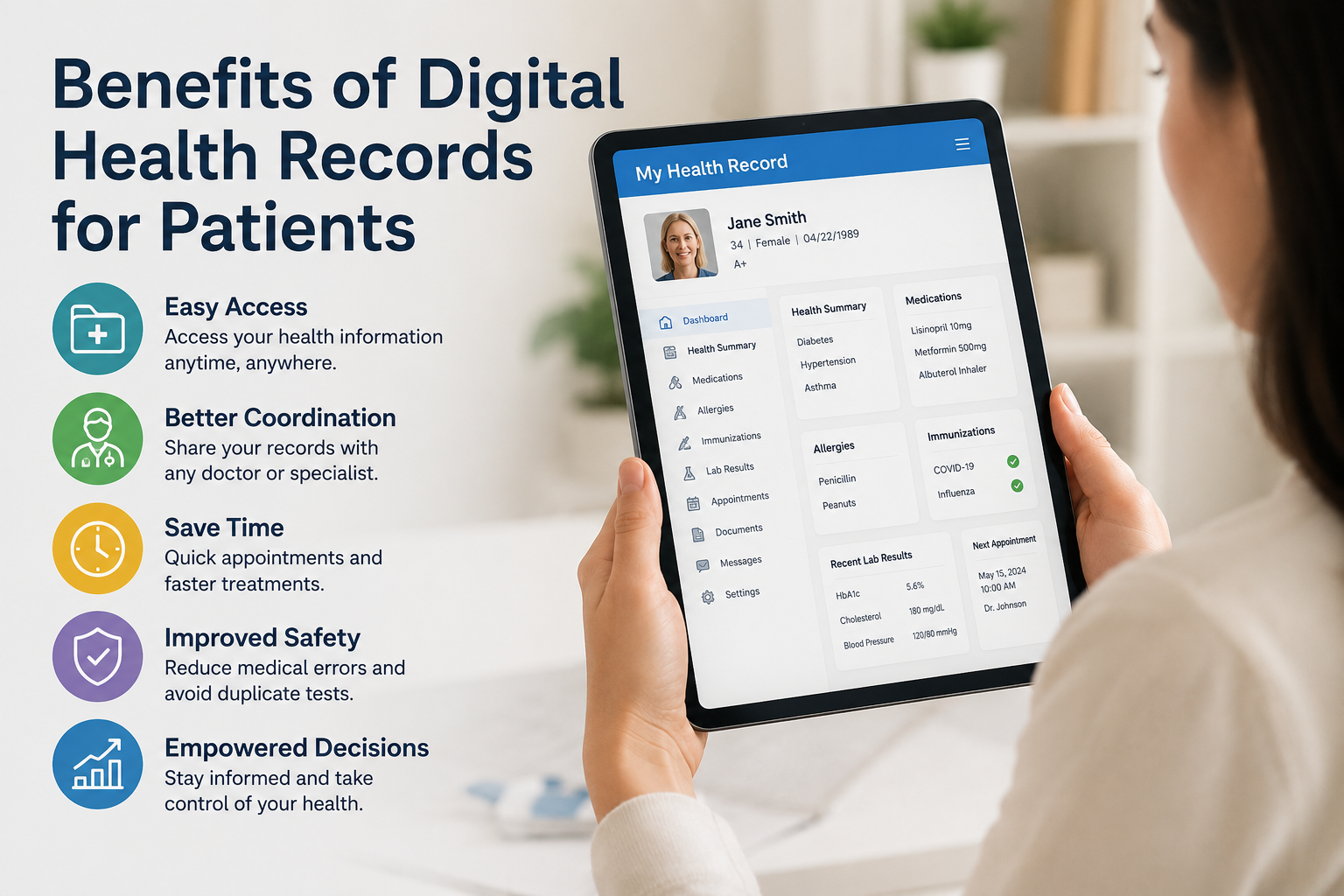
Benefits of Digital Health Records for Patients and Healthcare Providers
Digital health records get used everywhere in healthcare today, but what they are doing for patients and providers is something most people barely think about. Most people who come across digital health records treat them as nothing more than paper files gone digital. Faster access to information, fewer mistakes, better coordination between doctors and specialists; all of this is already happening, and all of it goes largely unnoticed.
What feels like a minor administrative upgrade might be one of the most significant changes in how healthcare is delivered today. And what seems like something that only benefits hospitals might just be changing the experience of every patient who walks through a clinic door.
Today, let us understand the benefits of digital health records for patients and healthcare providers so that every person can understand what is changing and why it matters.
More Than Just a Digital Filing System
Nothing about this looks like a big deal if you are just watching from the outside. Forms get filled the same way; the doctor stays the same; the care feels the same too. And yet, underneath all of that, something has been moving, quietly reshaping how information gets stored, pulled up, and passed between people, and that shift ends up touching the actual quality of care in ways that are easy to miss. It usually takes a while before anyone clocks that the difference was already there.
Digital health records are not just a more convenient way of storing paper files. They are changing how healthcare is delivered at every level.
What Digital Health Records Actually Are
A digital health record is an electronic version of a patient's complete medical history. Diagnoses, medications, test results, allergies, and treatment history. All of them are stored in one place and accessible to authorized healthcare providers instantly. Unlike paper records that sit in a filing cabinet in one location, digital health records can be accessed by any authorized provider regardless of where the patient is being treated.
People usually think of digital health records as something that only matters to the administrative side of healthcare without connecting it to the quality of care they receive directly. But the information a doctor has access to when making a decision about a patient's treatment directly affects the outcome of that treatment.
How Patients Benefit
Continuity of care is the benefit patients feel first. Whether it is a new doctor, a specialist, or an emergency department, a patient no longer must lean on their own memory to fill in medical history. All of that is already sitting there, accurate and complete, waiting to be pulled up.
Medication errors drop significantly too. When digital health records are being used in the way, they are meant to be. Every new prescription now carries a check with it automatically; the doctor can see what a patient is already on and spot any interaction risk before it turns into something real. The tie between accurate medication and accurate records is not something most people ever stop thinking about, but it is a direct one, and it plays into patient safety in a genuinely everyday way.
Waiting times are also affected. When a doctor already has access to a patient's test results, previous diagnoses and treatment history before the appointment even begins; the consultation is more focused and more efficient. Less time is spent gathering information that already exists, and more time is spent on the actual care being provided.
How Healthcare Providers Benefit
The benefits run just as deep on the provider side. The first time a doctor sits down with a new patient, whatever is clinically relevant about them is already available, sitting there ready to be reviewed. Nothing missing, no gaps to account for, no need to rely on the patient's memory for details that could genuinely matter.
Coordination between different providers is also transformed. A patient being treated by a GP, a specialist, and a hospital no longer falls through the gaps between those different parts of the system. Each provider can see what the others have done, what has been prescribed, and what has already been tried. This kind of coordination was simply not possible with paper records in the same way.
Administrative efficiency is another significant benefit. Less time spent on paperwork, fewer duplicate tests being ordered because results are already on record, faster processing of referrals and prescriptions. If healthcare providers spend less time on administrative tasks, then they are able to spend more time on patient care.
The Impact on Healthcare as a System
The benefits of digital health records extend beyond individual patients and providers to the healthcare system as a whole. Data from digital health records can be analyzed to identify patterns in how diseases are presenting, how treatments are performing and where resources are needed most. This kind of population level insight was not possible when records were kept on paper.
Public health decisions, resource allocation, and medical research all benefit from the kind of data that digital health records make available. A condition that is presenting more frequently in a particular area, a treatment that is showing unexpected results across a large number of patients. These are patterns that can now be identified and acted in ways that were not previously possible.
What Still Needs Attention
Digital health records are not without challenges. Privacy and data security are concerns that need to be taken seriously. A system that stores sensitive medical information about a large number of people is a system that needs to be properly protected. People usually put data security down to something that only matters in a corporate context without connecting it to their own medical records, but the protection of health data is something that every patient has a direct interest in.
Interoperability is another challenge. Digital health records are only as useful as the ability of different systems to communicate with each other. A record stored in one hospital system that cannot be accessed by another is not delivering the full benefit that digital health records make possible.
When to Consult a Doctor
Digital health records support better healthcare, but they are not a substitute for medical consultation. If a symptom has been continuing for a longer period without any clear reason, then a doctor should be consulted rather than relying on any digital tool or online information.
If there are concerns about the accuracy of information in a health record, then a doctor or healthcare provider should be contacted to review it. It is always better to consult a doctor for all health decisions regardless of what any digital system suggests or displays.
Conclusion
Digital health records are something which is very commonly used in healthcare today, but the full extent of what they are doing for patients and providers is something most people are not fully aware of. This change is already happening in healthcare systems around the world even when everything seems to be working the same way it always has from a patient's perspective. The best way to engage with this change is quite simple.
Understanding what digital health records are doing for the quality of care being received, staying informed about how health data is being used, and continuing to consult medical professionals for all health decisions is what makes the real difference. Healthcare is changing and being aware that change always leads to better outcomes.
FAQs
1. What are digital health records?
An electronic version of a patient's complete medical history including diagnoses, medications, test results and treatment history. All of them are stored in one place and accessible to authorized healthcare providers instantly.
2. How do digital health records benefit patients?
Better continuity of care, fewer medication errors, and more efficient consultations. A doctor already has the relevant information before the appointment begins, which means more time is spent on actual care.
3. How do digital health records benefit healthcare providers?
Immediate access to a patient's full medical history, better coordination between different providers, and significant administrative efficiency. Less time on paperwork means more time for patient care.
4. Are digital health records secure?
They are designed to be, but data security is something that needs ongoing attention. Healthcare providers are responsible for protecting patient data, and patients have the right to know how their information is being used.
5. Can patients access their own digital health records?
In most healthcare systems, yes. Patients can request access to their own records and review the information being held about them. It is always better to consult a doctor if there are any concerns about the accuracy of the information on record.